To friends of Bimblebox:
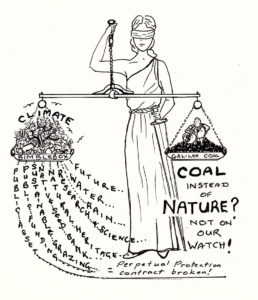
You know that President Kingham of the Qld Land Court has made a landmark recommendation to the Qld Govt. that it refuse the applications by Clive Palmer’s Waratah Coal Pty Ltd for a Mining Lease (ML) and an Environmental Authority (EA). Their proposed Galilee Coal Project area includes the Bimblebox Nature Refuge (BNR).
But BNR is not safe yet.
We need your help to encourage the relevant Qld Government decision makers to accept that recommendation and not give in to the coal lobby. Suggested emails and contact details are provided below.
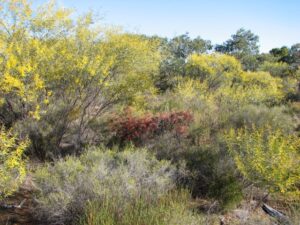
The BNR, in central Queensland, has protected quintessential Australian bush for over two decades through the tireless efforts of its owners and volunteers. BNR is not only a home for hundreds of plant and animal species, but also a place for research, a study in sustainable agricultural practices, and the focal point of the Bimblebox Art Project. President Kingham concluded, amongst other findings regarding climate change and human rights, that the loss of Bimblebox as a Private Protected Area was not in the public interest.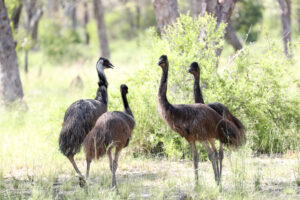 However, the final decisions rest with Scott Stewart, the Minister for Natural Resources, Mines and Energy, for the ML, and with Meaghan Scanlon, the Minister for the Environment and the Great Barrier Reef and Minister for Science and Youth Affairs, for the EA.
If upheld, it will have unprecedented detrimental consequences for the whole of the thermal coal industry and that is why it is no doubt being opposed by Mining representatives.
We would really appreciate it if you could urgently email these Ministers, as well as the Premier, urging them to accept the Land Court’s recommendation. Copy and paste the email contents or rephrase in your own words, but note that slightly different emails are needed for the different people. Your name and address has to go at the end of each email.
Thank you for your support,
The Bimblebox Alliance Committee
ML: Scott Stewart, Minister for Resources; email: resources@ministerial.qld.gov.au
Dear Minister Stewart,
Land Court recommendation against mining of the Bimblebox Nature Refuge.
I am writing to urge you to accept the Land Court’s recommendation not to issue a Mining Lease (ML) for Clive Palmer’s Waratah Coal for their Galilee Coal Project, which would include mining beneath the Bimblebox Nature Refuge.
President Kingham of the Land Court heard extensive evidence from both sides over six weeks, from over twenty expert witnesses and six lay witnesses, and her findings are unequivocal.
In her decision President Kingham stated “… Bimblebox plays a critical role in biodiversity conservation. Its ecological value is recognised under commonwealth and state conservation regimes. The owners have carefully managed Bimblebox to eradicate or control invasive species. The long-term grazing trials and other research provide a valuable contribution to our knowledge base for developing sustainable land management. It has nurtured a creative community which has successfully exhibited both the productivity of the camps and the importance of places like Bimblebox.”
The President further concluded that “The risk of the loss of Bimblebox as a nature refuge was both real and likely if the mine proceeded.” And that included offsets.
She decided that, weighing the benefits of the Project against the loss of Bimblebox, the public interest does not favour the Project.
No doubt the Mining sector representatives may have other views (they have had their chance, and took it, to put them forward in the Land Court hearings) but it would create a dreadful precedent if the recommendation of the Land Court was overruled. It would also erode public confidence in the rigorous system that has served Queensland well.
I urge you to ensure that the recommendation is accepted.
Yours sincerely,
(your name and address)
EA: Meaghan Scanlon, Minister for the Environment and the Great Barrier Reef and Minister for Science and Youth Affairs; email: environment@ministerial.qld.gov.au
Dear Minister Scanlon,
Land Court recommendation against mining of the Bimblebox Nature Refuge.
I am writing to urge you to accept the Land Court’s recommendation not to issue an Environmental Authority (EA) for Clive Palmer’s Waratah Coal for their Galilee Coal Project, which would include mining beneath the Bimblebox Nature Refuge.
President Kingham of the Land Court heard extensive evidence from both sides over six weeks, from over twenty expert witnesses and six lay witnesses, and her findings are unequivocal.
In her decision President Kingham stated “… Bimblebox plays a critical role in biodiversity conservation. Its ecological value is recognised under commonwealth and state conservation regimes. The owners have carefully managed Bimblebox to eradicate or control invasive species. The long-term grazing trials and other research provide a valuable contribution to our knowledge base for developing sustainable land management. It has nurtured a creative community which has successfully exhibited both the productivity of the camps and the importance of places like Bimblebox.”
The President further concluded that “The risk of the loss of Bimblebox as a nature refuge was both real and likely if the mine proceeded.” And that included offsets.
She decided that, weighing the benefits of the Project against the loss of Bimblebox, the public interest does not favour the Project.
No doubt the Mining sector representatives may have other views (they have had their chance, and took it, to put them forward in the Land Court hearings) but it would create a dreadful precedent if the recommendation of the Land Court was overruled. It would also erode public confidence in the rigorous system that has served Queensland well.
I also wish to remind you of your words in a media release (10 July 2021) that ‘nature refuge landholders were dedicated to the environment, preserving their land for future generations and complementing the State Government’s role in growing and managing Queensland’s protected area network. They do a fantastic job and help to ensure the ongoing success of Queensland’s Private Protected Area Program.’ https://statements.qld.gov.au/statements/92632
Please stand by your statement and your conviction, and give the Bimblebox landowners a break after 15 years of fighting against this coal project.
I urge you to ensure that the recommendation is accepted.
Yours sincerely,
(your name and address)
General: Annastacia Palaszczuk, Premier;p email: thepremier@premiers.qld.gov.au
Dear Premier Palaszczuk,
Land Court recommendation against mining of the Bimblebox Nature Refuge.
I am writing to urge you to ensure the acceptance of the Land Court’s recommendation not to issue an Environmental Authority (EA) and a Mining Lease (ML) for Clive Palmer’s Waratah Coal for their Galilee Coal Project, which would include mining beneath the Bimblebox Nature Refuge.
President Kingham of the Land Court heard extensive evidence from both sides over six weeks, from over twenty expert witnesses and six lay witnesses, and her findings are unequivocal.
In her decision President Kingham stated “… Bimblebox plays a critical role in biodiversity conservation. Its ecological value is recognised under commonwealth and state conservation regimes. The owners have carefully managed Bimblebox to eradicate or control invasive species. The long-term grazing trials and other research provide a valuable contribution to our knowledge base for developing sustainable land management. It has nurtured a creative community which has successfully exhibited both the productivity of the camps and the importance of places like Bimblebox.”
The President further concluded that “The risk of the loss of Bimblebox as a nature refuge was both real and likely if the mine proceeded.” And that included offsets.
She decided that, weighing the benefits of the Project against the loss of Bimblebox, the public interest does not favour the Project.
No doubt the Mining sector representatives may have other views (they have had their chance, and took it, to put them forward in the Land Court hearings) but it would create a dreadful precedent if the recommendation of the Land Court was overruled. It would also erode public confidence in the rigorous system that has served Queensland well.
I also wish to remind you of your Minister Scanlon’s words in a media release (10 July 2021) that ‘nature refuge landholders were dedicated to the environment, preserving their land for future generations and complementing the State Government’s role in growing and managing Queensland’s protected area network. They do a fantastic job and help to ensure the ongoing success of Queensland’s Private Protected Area Program.’ https://statements.qld.gov.au/statements/92632
Please stand by this conviction, and give the Bimblebox landowners a break after 15 years of fighting against this coal project.
I urge you to ensure that the recommendation is accepted.
Yours sincerely
(your name and address)









 To win this fight, The Bimblebox Alliance Inc. needs YOU.